Bessbrook
The Bessbrook you see today dates from 1845 when the mill in Bessbrook was purchased by the Quaker Richardson family. They built the present village in order to provide accommodation for the mill workers. The village was a social experiment based on Quaker ideals of temperance, earning it the title of ‘The Model Village’. It was also often called the village of the ‘three Ps’: no public house, no pawn shop, and consequently no need for police. The streets, terrace houses and squares of Bessbrook are all made from the local hard-wearing Bessbrook granite. Bessbrook was the inspiration for the later model village built by Cadbury at Bourneville near Birmingham
Bessbrook Mill
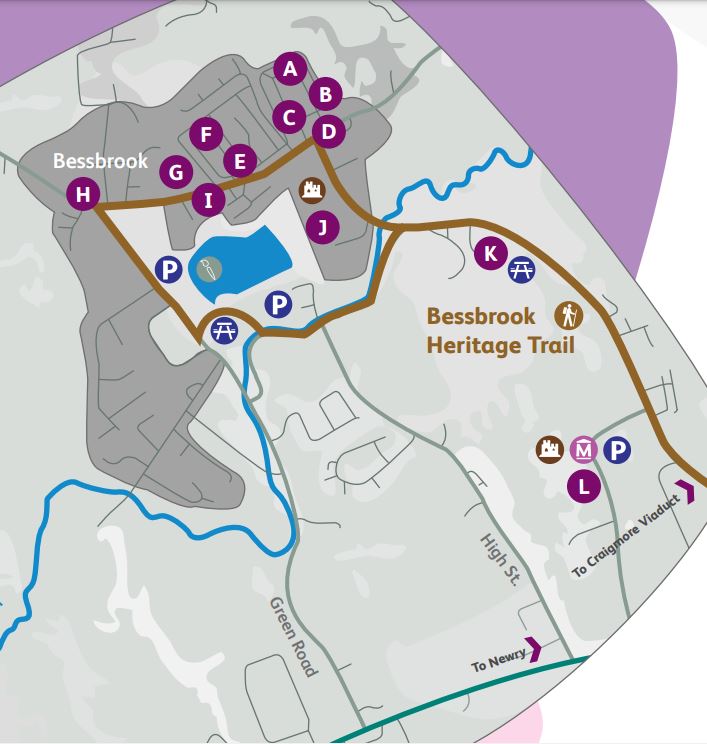
Bessbrook Mill was the centre of the Richardson enterprise in Bessbrook. By 1878, 33 years after its acquisition, it employed approximately 3,000 workers in the mill and 1,500 outworkers (mainly handloom weavers). Linen production continued under Bessbrook Spinning Company until 1972, when the site was taken over by Ulster Weavers, and production finally ceased in 1987. The site was then used as an army base until 2007. Bessbrook Mill was constructed with granite in stages between 1845 and 1880. The architect was W J Gililand and the Mill is a B1 Listed Building. It is an interesting piece of 19th century industrial architecture in terms of its huge size and in the quality of its construction, for example, the former engine house has fine Arts & Crafts influenced detailing. While access to the site is not possible at present visitors can get a good view of the mill from the small business/shop units off Mill Road and see part of the weaving sheds from the Boiler Hill section of Derrymore Road.
Craigmore Viaduct
The highest railway bridge in Ireland carries the rail link between Belfast and Dublin. Construction began
in 1849 and the bridge opened in 1852. Designed by Sir John McNeill, the eighteen arch viaduct sweeps in a curve across the valley, 126 feet above the Camlough River. The disused track of the Bessbrook to Newry tramway runs underneath the viaduct and is now part of The Ulster Way and The Ring of Gullion Way.
Derrymore House
Built in the last quarter of the eighteenth century at the instigation of Isaac Corry. He was the Member of Parliament for Newry from 1776 until 1806 and was Chancellor of the Irish Parliament at the time of the passing of the Act of Union in 1801. It was later acquired by John Grubb Richardson, whose grandson John S. Wakefield Richardson gave it to the National Trust. The surrounding park and woodlands are open to the public.
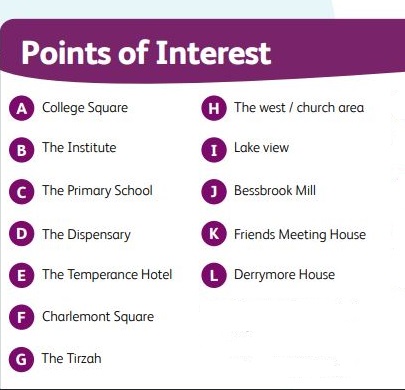
The Primary School
This two teacher school, built in1849, originally provided educationon an interdenominational basis.Beside the school are the teachers’semi-detached residences, built in a matching style.
College Square
This square was the second of theBessbrook Squares to be built. House No.6 along College Square East,originally a mill worker’s dwelling,has been acquired by Bessbrook Development Company Ltd and restored to what it was like when first inhabited in 1881.
The Dispensary
This was opened for use in 1876to replace the former building inFountain Street. From here a doctorand nurse, employed by The Spinning Company, gave medical advice and dispensed medicines to the employees. With the introduction of national medical insurance in 1912, the company scheme became redundant and the vacant building became a public bath-house. It is now business premises
Lakeview
These four large houses overlooking the pond were traditionally occupied by the members of the upper management of the Bessbrook Spinning Company.
Charlemont Square
This square was the first to be built to realise the Richardson plan of low density housing for his workers. The east side was built with provision for five shops where individuals could setup their own businesses.
The Temperance Hotel
Now empty, but was also the former Post Office, this large house provided accommodation for commercial travellers, visitors and school teachers until they established more permanent living arrangements.
The west/church area
The major denominations of thelatter half of the nineteenth centuryall had adherents in Bessbrook. Theremains of one of the oldest buildings in the area, the Caulfield Bawn, are inthe grounds of the Old Convent. Built about 1625 as a place of safety, at the instigation of Sir Toby Caulfield, only a small piece of wall now remains.
The Tirzah
Tirzah is a Hebrew word which means‘she is my delight’. The Tirzah in Bessbrook was created as a small park or place of rest and its unusual name refers to it being ‘a pleasant place’ where the villagers could ‘rest a while’.
The Institute
Constructed from local blue granite in 1885, by local craftsmen. It was erected as a meeting, educational
and recreational facility. Soon after its completion, it became known as the Town Hall.
Friends Meeting House
Located in the grounds of Derrymore estate this solid granite structure opened for worship in 1864 and was built by John Grubb Richardson. The Woodhouse, his Bessbrook residence, lies a few hundred yards from the Meeting House.